
by Lews Carrol – reviewed by Circe Aguiar
Alice’s Adventures in Wonderland is a masterpiece of imagination, full of wordplay, whimsy, and more profound meaning beneath the nonsense.
The curious journey begins when a young girl named Alice follows a talking White Rabbit down a rabbit hole, and suddenly finds herself in a strange world where nothing makes sense in the usual way. In Wonderland, animals speak, logic is flipped upside down, and rules seem to change every minute.
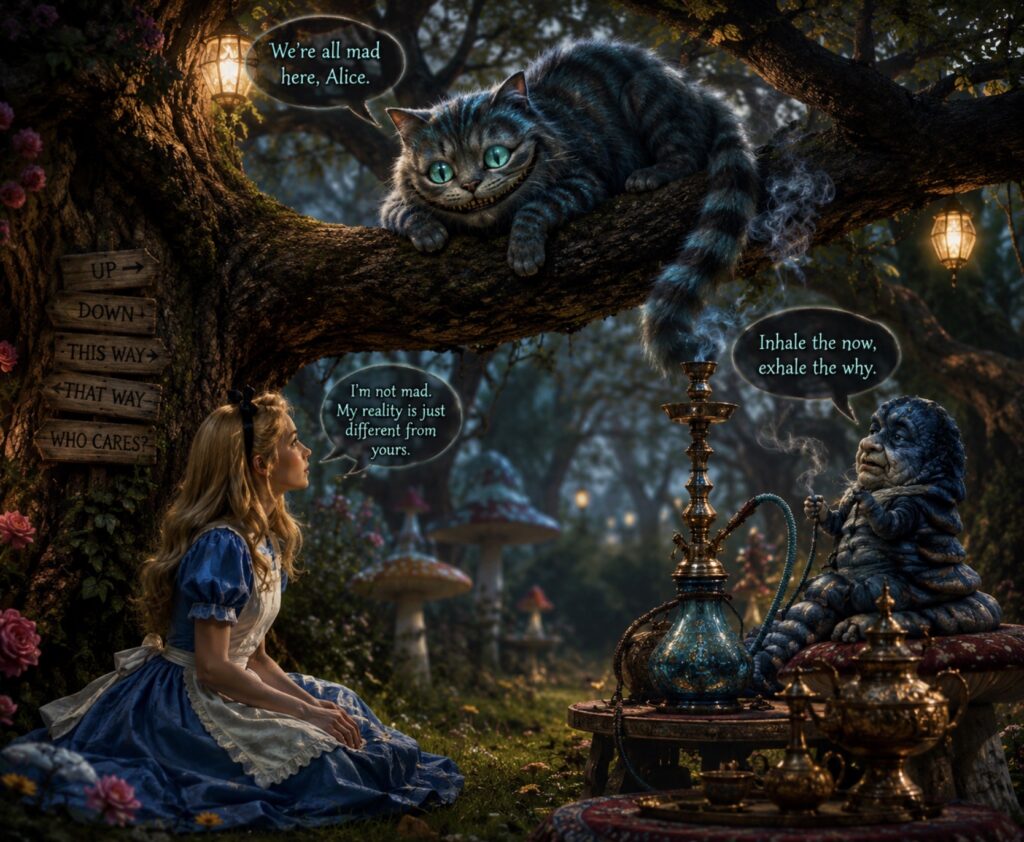
Throughout her adventure, Alice meets many unforgettable characters: the grinning Cheshire Cat who gives mysterious advice, the Mad Hatter and March Hare who host a never-ending tea party, the sleepy Dormouse, the grumpy Queen of Hearts who shouts “Off with their heads!”, and many more. Each one is delightfully odd and challenges the way Alice sees the world.
Though the story is playful and full of nonsense, Lewis Carroll (whose real name was Charles Dodgson) was a mathematician and loved using logic puzzles, riddles, and clever language. The book is rich in wordplay, such as puns and twisted nursery rhymes. Alice often finds herself frustrated by characters who don’t make sense, reflecting a child’s experience of trying to understand the confusing world of adults.
.
And here follows a favorite excerpt
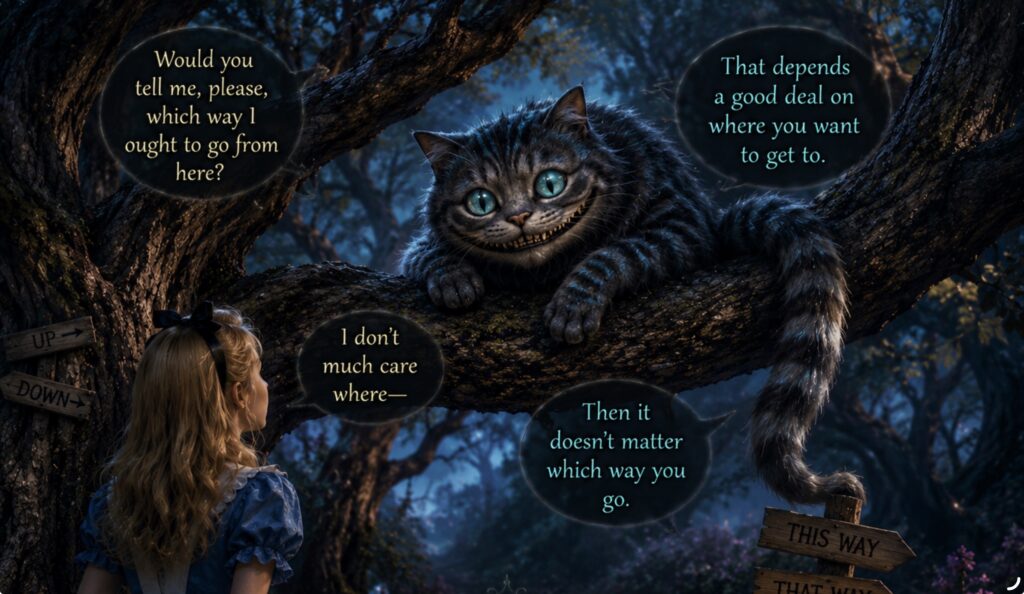
“Would you tell me, please, which way I ought to go from here?”
“That depends a good deal on where you want to get to,” said the Cat.
“I don’t much care where” said Alice.
“Then it doesn’t matter which way you go,” said the Cat.
It sounds simple at first, almost playful. But beneath it there is something sharp: direction gives meaning to movement. Without it, even constant motion can become wandering disguised as progress.
And yet there is another side too, sometimes people only discover where they truly want to go by walking through strange forests first. Alice herself did not enter Wonderland with a map.
Alice’s Adventures in Wonderland explores themes like growing up, questioning authority, and discovering identity. As Alice navigates Wonderland, she begins to think for herself and gain confidence in who she is. The story encourages readers to stay curious, be brave, and embrace the power of imagination.
Lewis Carroll’s inventive style, combined with John Tenniel’s original illustrations, has made Alice in Wonderland a timeless classic that speaks to children and adults. It’s a story that delights with nonsense on the surface, but rewards those who look deeper with wisdom, humor, and truth
